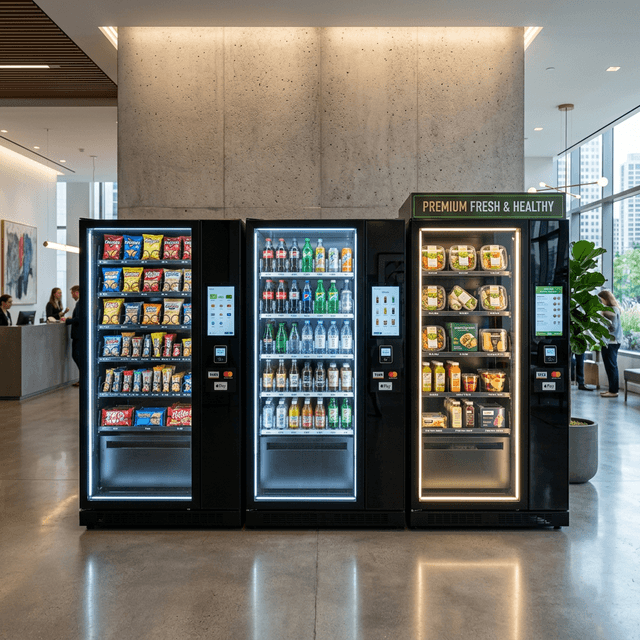
A useful break room starts with the people who use it. A downtown Denver office with changing attendance needs a different setup from a warehouse running multiple shifts or a clinic where visitors share a waiting area. Buying the largest machine or choosing the broadest menu first can leave you with equipment that occupies valuable space while failing to meet daily needs. Start with a site plan, then choose the service.
This guide helps Denver facility managers, business owners, and HR teams prepare a clear brief for vending and micro market proposals. It covers practical decisions you can make before a site visit and questions to settle in writing before installation. The examples are planning scenarios, not promises about any particular building or service package.
1. Measure attendance instead of using payroll headcount
List how many people are physically present on a normal day. A business with a large employee roster may have a smaller on-site audience if staff work remotely, travel, or divide their week among locations. Conversely, a modest permanent team may serve contractors, visitors, and seasonal employees. Estimate those groups separately so your operator can understand who will buy products and when.
Use a simple two-week observation period where possible. Record arrivals by shift, lunch patterns, break times, and the busiest day of the week. You do not need individual employee tracking. An aggregate count from an existing attendance process or a facilities estimate is usually a more useful starting point than an optimistic maximum. Identify unusual events so they do not distort a typical week.
For a Denver office near a transit stop, employees may prefer carrying fewer items on their commute. RTD describes its EcoPass program as an employer-purchased annual transit pass. If your workplace participates, ask staff about practical breakfast, beverage, and lunch needs. Transit participation is a reason to ask better questions, not evidence that vending demand will be high.
For shift workplaces, build a small table with each shift's attendance, break window, and available nearby food options. A crowded lunch interval might require more than one checkout point even when overall daily attendance is moderate. A quiet overnight shift might need dependable shelf-stable products rather than a large fresh-food selection. Explain both situations in your quote request.
2. Match the format to access and buying habits
Traditional vending machines keep products enclosed until a purchase completes. They can suit visitor areas, smaller break rooms, and spaces where access is difficult to control. Compare the actual product capacity, payment methods, vend sensors, and refund process. The machine footprint is only part of the space requirement: people still need room to approach it and open doors for servicing.
Micro markets combine open shelves, coolers, and self-checkout. Staff can inspect a package before buying, and the format can accommodate a wider product mix. Open access also means a payment kiosk cannot physically stop unpaid removal. Employee-only entry, appropriate monitoring disclosures, clear checkout instructions, and an agreed responsibility for losses matter as much as the equipment.
Do not treat a specific employee count as an automatic qualification threshold. An operator may consider daily attendance, buying patterns, opening hours, other food options, restocking travel, and security together. A larger workplace with extensive complimentary food may have less paid demand than a smaller site with few alternatives. Ask how the operator evaluates your particular location rather than relying on a generic rule.
Office coffee service and pantry service solve a different problem: the employer usually funds some or all consumption. They may complement vending instead of replacing it. Decide which items are an employee benefit, which items employees purchase, and whether the boundary is clear enough that a new hire can understand it immediately.
3. Walk the building before agreeing on equipment
Prepare photographs and rough measurements of the intended area, but also trace the installation route from delivery entrance to final position. Check doors, elevators, turns, floor transitions, stairs, and service access. Ask the equipment provider for exact dimensions, weight, ventilation clearances, and any delivery requirements. A machine that fits its final wall may still be impossible to move there through the available corridor.
Keep equipment away from required exit paths and avoid turning a hallway into a queue. Discuss accessible approach, payment controls, and product reach with the appropriate building professional. Provide the operator with the building's rules for deliveries and contractor access. Your property manager should approve the location before equipment is ordered, especially where a shared lobby or tenant improvement is involved.
Check power with your facilities team. Do not assume an available socket has suitable capacity or that an extension cord is an acceptable permanent solution. Refrigeration, coffee equipment, and payment systems may have different electrical needs. Clarify who pays for electrical work, how utility consumption is handled, and what happens if the chosen location needs a dedicated circuit or additional outlets.
Water-connected coffee equipment introduces plumbing and maintenance questions. Ask whether the proposed unit needs a water line, drain, filtration, or another approved arrangement. Assign responsibility for filters, leaks, cleaning, and shutdowns. If your workplace moves often or has limited infrastructure, discuss a simpler configuration before committing to construction that may be costly to reverse later.
4. Plan around Denver metro access and jurisdiction
A service-area page is a starting point for an inquiry, not a guarantee that every building can be placed on a route. Downtown deliveries, suburban offices, industrial sites, and facilities near the airport can have very different access conditions. Explain parking availability, loading restrictions, freight elevator reservations, badging, and whether a driver can service equipment during normal working hours.
If your site is in Aurora, Lakewood, or another metro municipality, give the actual address and jurisdiction rather than describing everything as Denver. The relevant local authority and building requirements may differ. Our service-area directory helps you locate information, while a site assessment establishes the specific route, equipment, and service possibilities for your business.
Denver's business licensing guidance explains that food operations are among the businesses it licenses. Jefferson County also publishes retail food regulation information. These are useful starting points for identifying the appropriate authority. Ask the operator and local agency to confirm the requirements for your exact equipment and product format before opening.
Build seasonal contingencies into the service conversation without promising uninterrupted access. Ask how weather, building closures, or a restricted loading entrance affect restocking and repairs. Provide an alternate facilities contact and a process for notifying the operator when the site closes. Keeping that information current can prevent a driver arriving at a locked building while staff wait for replenishment.
5. Separate no-cost placement from consumption costs
No-cost placement generally describes a qualifying equipment arrangement, not free products for everyone. An operator may fund equipment and earn income from product sales when a location meets its assessment criteria. Eligibility depends on the site's expected usage, service access, security, and the proposed terms. Until your location is approved and the agreement is documented, treat no-cost placement as an option to discuss.
Ask the proposal to distinguish equipment, delivery, installation, normal servicing, repairs, and removal. Identify what the business pays directly and what is supported by retail sales. Confirm whether utility work, unusual delivery requirements, damage, special products, or relocation are outside the standard arrangement. This makes it easier to compare offers that use the same headline but include different responsibilities.
Employees typically pay listed prices for vending or micro market purchases. If the employer subsidizes products, clarify whether the subsidy covers a fixed amount, selected categories, or a monthly allowance. Ask how transactions are recorded, what reporting is available, and how the subsidy ends or changes. A benefit can be generous while still requiring a clear budget and reconciliation process.
Pantry and coffee programs should have their own budget. Write down included products, equipment rental if applicable, supplies, restocking labor, service charges, and billing frequency. A complimentary employee snack is still a business expense. Avoid comparisons based only on an equipment placement cost when one proposal sells products to employees and another invoices the employer for all consumption.
6. Build a menu from real preferences
Survey staff using a few concrete questions: preferred beverages, usual snack occasions, interest in meals, and dietary preferences they choose to share. Avoid collecting medical details or linking answers to individuals. Separate must-have categories from nice-to-have brands. A workable initial assortment balances employee interest with shelf life, available space, and the number of people actually shopping.
Include choices beyond sweet snacks and soda, but do not promise that every product marketed as healthy fits everyone's needs. Employees should be able to review package labels, ingredients, and allergen information. Ask how substitutions are communicated and whether the operator can maintain agreed categories when a brand is unavailable. Packaging changes are a reason to read labels again, even for familiar products.
Fresh sandwiches, salads, yogurt, and other refrigerated products need a credible replenishment and temperature-control plan. Ask the operator how dates are checked, how expired items are removed, and what procedure follows a refrigeration failure. Start with a manageable assortment and expand when demand supports it. A broad menu is less useful if low-turnover products repeatedly expire before anyone buys them.
For coffee, consider brew size, preparation time, cleaning, and the supplies needed alongside the drink. Cups, lids, stirrers, filters, sweeteners, and alternatives to dairy can create separate restocking tasks. Name the person who checks daily cleanliness and the provider who performs equipment servicing. Clear ownership prevents an attractive coffee station becoming an unmaintained corner of the break room.
7. Make payment and support easy to understand
Ask which payment methods the proposed equipment actually supports. Contactless cards, mobile wallets, cash, accounts, or employee allowances may be available on different systems, but availability should be confirmed for your installation. Test payment connectivity in the intended position before launch. A cellular signal that works near a window may be unreliable inside a lower-level break room.
Ask what happens when a transaction succeeds but an item does not dispense. Each machine or market should display a support process that visitors can find without asking HR. Confirm the information needed for a refund, the person handling requests, and the expected communication process. Avoid displaying a generic or placeholder number that sends customers to the wrong business.
Keep privacy questions practical. If a market uses cameras or purchase accounts, ask what information is collected, who can access it, how long it is retained, and how employees are informed. Position notices so people see them before using the area. Facilities staff should also understand how monitoring interacts with the building's own policies and any employee communications process.
Plan for a network or power outage. Ask whether purchases can continue safely, whether refrigerated products must be withheld, and who decides when normal operation resumes. Give staff a simple notice and support route instead of leaving them to guess. Any fallback should match the actual equipment's capabilities; do not assume offline payment is enabled just because another system offers it.
8. Compare proposals using the same written brief
Send each prospective operator the same site information: address, typical attendance, shifts, intended area, service access, and product priorities. Include photos and your desired launch window. State whether the employer funds products or employees purchase them. A consistent brief makes differences between proposals easier to spot and reduces repeated conversations about missing details.
Read the service agreement for its length, renewal process, cancellation notice, removal obligations, and relocation terms. Confirm equipment ownership and the party responsible for damage or loss. Ask whether exclusivity applies to the entire property or only the equipment area. Do not assume a general marketing phrase about flexibility overrides the agreement you are being asked to sign.
Compare restocking expectations and repairs separately. A routine delivery schedule does not establish an emergency response commitment. Discuss low-stock notices, holiday changes, urgent refrigeration issues, and how employees report a problem. Ask for a documented escalation process and confirm which contact is available during your operating hours. Keep the final version accessible to the site manager.
For a micro market, ask who owns shelving, coolers, kiosks, and account data when the arrangement ends. For an employer-funded program, ask how unused allowances or final invoices are reconciled. Thinking about an orderly exit before installation is normal procurement work. It helps you choose a program that can adjust when headcount, tenancy, or business needs change.
9. Launch with a small, repeatable checklist
Before the first day, check the final equipment location, power, connectivity, support signage, listed prices, and the initial product assortment. Ask the operator to demonstrate an ordinary purchase and a support request without creating unnecessary transactions. Make sure the installation leaves aisles and access clear. Photograph the finished arrangement for your facilities record and note any items awaiting correction.
Tell staff what is available, what they pay, and how the program works. Explain the distinction between employee-funded purchases and employer-funded pantry items. If there is a subsidy, provide a short example of how it applies. Include the support instructions and any monitoring notice in launch communications. Clear instructions can reduce confusion more effectively than a long promotional announcement.
Choose a review date after the program has operated through a representative attendance cycle. Ask about stockouts, unpopular products, checkout queues, and unresolved service issues. Review aggregate sales or consumption where appropriate, avoiding unnecessary individual tracking. Update the product mix in manageable steps so you can understand whether a change solves the problem or simply introduces more complexity.
Revisit the site brief when attendance changes materially. An office that adds another shift or adopts a different hybrid schedule may need new capacity, a different replenishment pattern, or another service format. Share changes early. The most useful long-term program is one that follows actual workplace behavior instead of staying tied to assumptions made before installation.
Prepare your Denver site assessment
Collect your daily attendance, shift schedule, location photographs, delivery restrictions, and intended funding model. Decide which services you want to compare and what success means for your team. With that information, a site conversation can focus on practical equipment, products, service responsibilities, and written costs rather than generic promises.
Request a Denver site assessment and quote to discuss vending, micro markets, coffee, or pantry options for your workplace. Include your city and business address so route eligibility can be assessed. No-cost placement is subject to site approval and agreed terms; product purchases and optional services remain separate considerations.